From awareness to community action: Empowering local communities to counter disinformation in Preah Vihear and Kampong Thom

Rural communities in Cambodia are experiencing disinformation on social media platforms. It has become an emerging community issue because not many community members have the capacity to verify the accuracy of information circulating online. The lack of understanding among communities has allowed the acceleration of false and misleading content. It can increase anxiety, influence decision-making, heighten tensions, affect reputation, and lead to a loss of trust, as well as certain economic benefits. This was particularly evident during the period of the Cambodia-Thailand border conflict, when large volumes of inaccurate information circulated widely.
Community-learning centers play a crucial role in educating rural communities. Led by the local communities, the centers provide an inclusive learning environment, established across the country and open for all community members to access informal education that will foster lifelong learning while driving economic growth and social development in Cambodia. Yet, the centers have had few opportunities to strengthen their own media and information literacy (MIL). This gap is making local community members vulnerable to disinformation. Against this backdrop, capacity building on media and information literacy is paramount to safeguard local communities.
How did Open Development Cambodia Organization (ODC) respond to the emergence of disinformation in rural areas?
In 2025, with funding support from the Organisation internationale de la Francophonie (OIF), Open Development Cambodia Organization (ODC), together with the Prayuters Library Program, organized a Training of Trainers (ToT) on Media and Information Literacy for members of community-learning centers and university students, with a strong emphasis on addressing disinformation. In collaboration with the National Committee for Lifelong Learning (NCLLL), the Cambodian government’s coordinating body for developing community-learning centers, the training introduced practical tools to help participants protect themselves and avoid falling victim to disinformation.
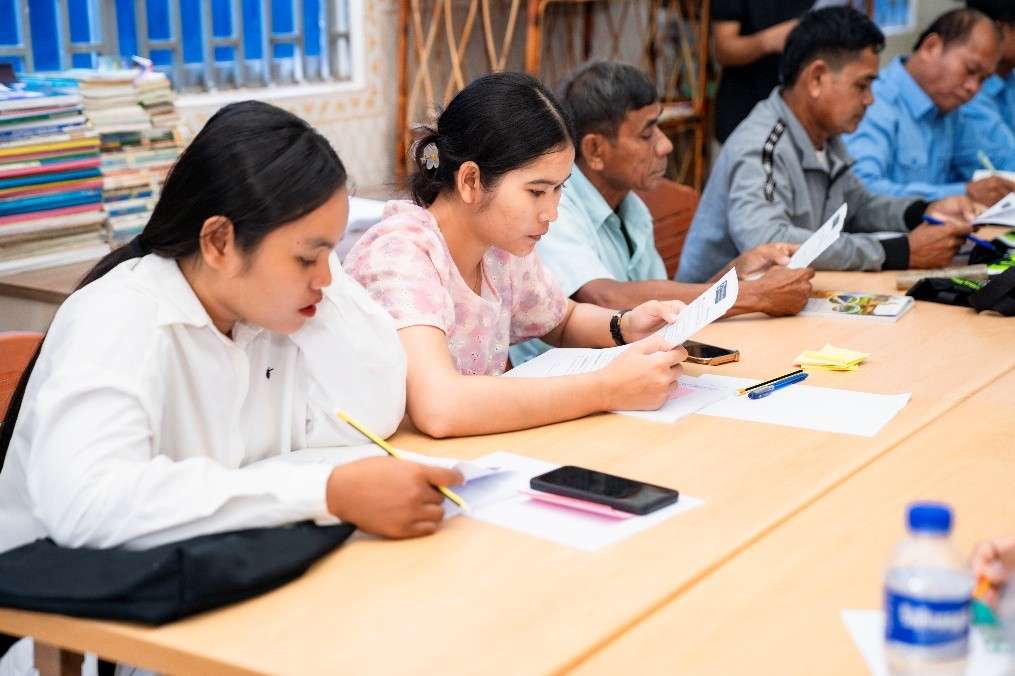
Knowing that disinformation was spreading and affecting people all around the communities, we also trained the ToT participants to become focal persons who would assist other members of their respective communities in detecting and preventing disinformation from circulating. Two separate ToT sessions were conducted in Preah Vihear and Kampong Thom, reaching a total of 29 participants. Over the course of two days, participants successfully absorbed the training modules, significantly boosting their self-efficacy for leading subsequent community-level workshops. A participatory approach was employed in the ToT to engage the participants in the learning process that could maximize their learning outcomes. A wide range of training sessions was thoughtfully designed to align with participants’ diverse backgrounds while ensuring that comprehensive MIL knowledge was transferred to all participants. The sessions include:
- Module 1: Introduction to Media and Information Literacy
- Module 2: What is Fake News?
- Module 3: Spotting Fake News
- Module 4: AI-Generated Content and AI Tools for Fact-Checking
- Module 5: Ethics of Social Media
- Module 6: Training Basics
How did the training program benefit local communities?
Through this ToT, members of the community-learning centers have developed their abilities to contribute to building safe and resilient communities, especially by bolstering resilience against the rising tide of disinformation. Surveys that we conducted to measure their understanding at the end of this training show a significant increase in knowledge relevant to information, types of media for disseminating information, associated risks that come with it and the impacts, ethical use of social media, and methods for identifying fake news on social media platforms.

Mr. Chan Serey Vuthy, a ToT participant who is working as the Deputy Director of the Education Office of Tbaeng Meanchey district, shared that “he had learned a lot” from this ToT in the follow-up interview that we conducted to assess the impacts of the project.
The co-facilitator of this training sees its importance particularly for communities in rural areas because they rarely have access to similar training opportunities that are truly relevant in their daily lives. Mr. Sreng Saren, who co-facilitated the training, stated that “without such a program, they would not have any chance to develop the digital and media skills.” During a period of conflict happening along the Cambodia-Thailand border, this training offered participants a great opportunity to learn this applicable knowledge as well as to get a sense of ease when a large amount of fake news from both sides was spreading. Mr. Saren stated that “at that time, misinformation was a serious problem, and people were anxious and uncertain.”
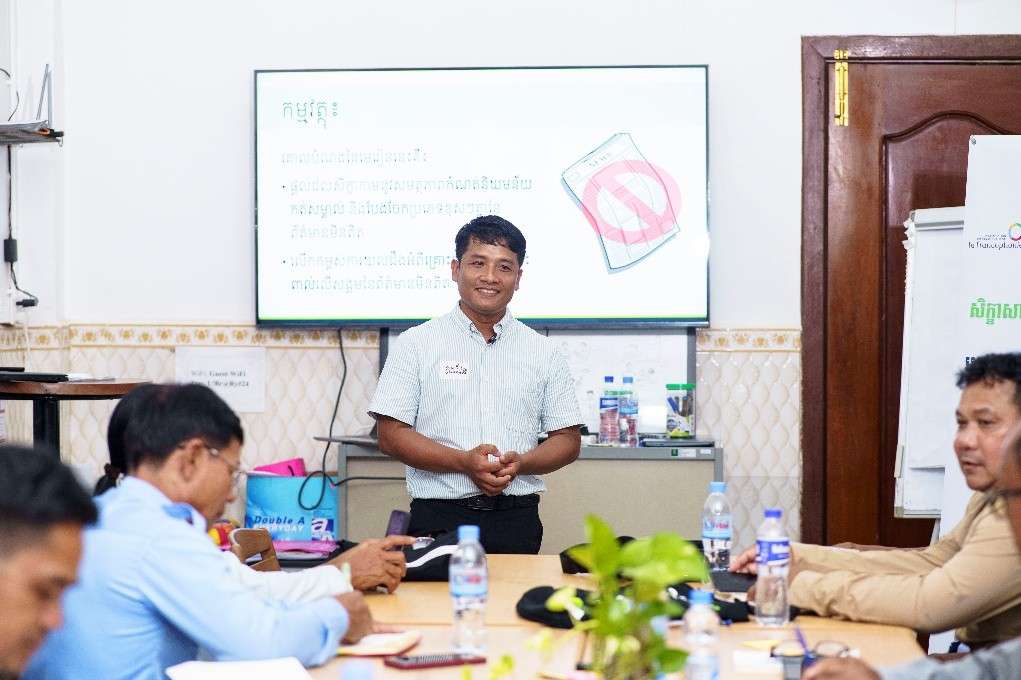
The ToT has not only benefited members of the community-learning centers, but also other people in the communities who did not have the opportunity to join this training. With the small grant and coordination support from ODC, ToT participants have similarly capacitated their fellow community members by utilizing knowledge and experiences from the ToT. At the end of the ToT, they teamed up to design and run 47 community workshops across the two provinces, with a total number of 1,969 participants, including 1,196 female participants, attending these workshops. The community workshops attracted people from diverse backgrounds in different corners of both provinces, including teachers, students from lower and higher education, parents of students, local community members, and commune council members.
In these community workshops, our focal persons frequently selected modules on methods for identifying or differentiating fake news because they observed that community members needed this knowledge the most. It was followed by ethics for social media users, including in relation to fake news, risks of fake news, and different types of media as well as their respective pros and cons. In an interview at the conclusion of the project, Ms. Buth Soklean, a youth focal person from Pahal Lifelong Learning Center, shared that “my students gained valuable skills in spotting fake news and analyzing the accuracy of information through the community workshops I facilitated.” She also noticed that these workshops “helped my students remain calm and avoid panic” caused by the spread of disinformation within their community.

Based on the observation of ToT participants during their respective community workshops, their participants actively engaged with them and their peers and showed their curiosity about the topics. This result was a direct reflection of the MIL knowledge and participatory approach they mastered during our ToT training. Mr. Vuthy described the experience throughout the whole project as “meaningful for him and his community.” He added that he is still motivated by what he has learned from the ToT because the spread of disinformation continues to exist in his community. Another focal person, Ms. Pol Sinorn, head of the Pahal Life-Long Learning Center, expressed her commitment to sharing the knowledge from the ToT following the closure of this project. By equipping them with the necessary skills and supporting them to organize these community workshops, the project has built the resilience of local communities against disinformation, and consequently, it may reduce the harmful impacts of disinformation on the communities, especially those who lack adequate understanding.

